
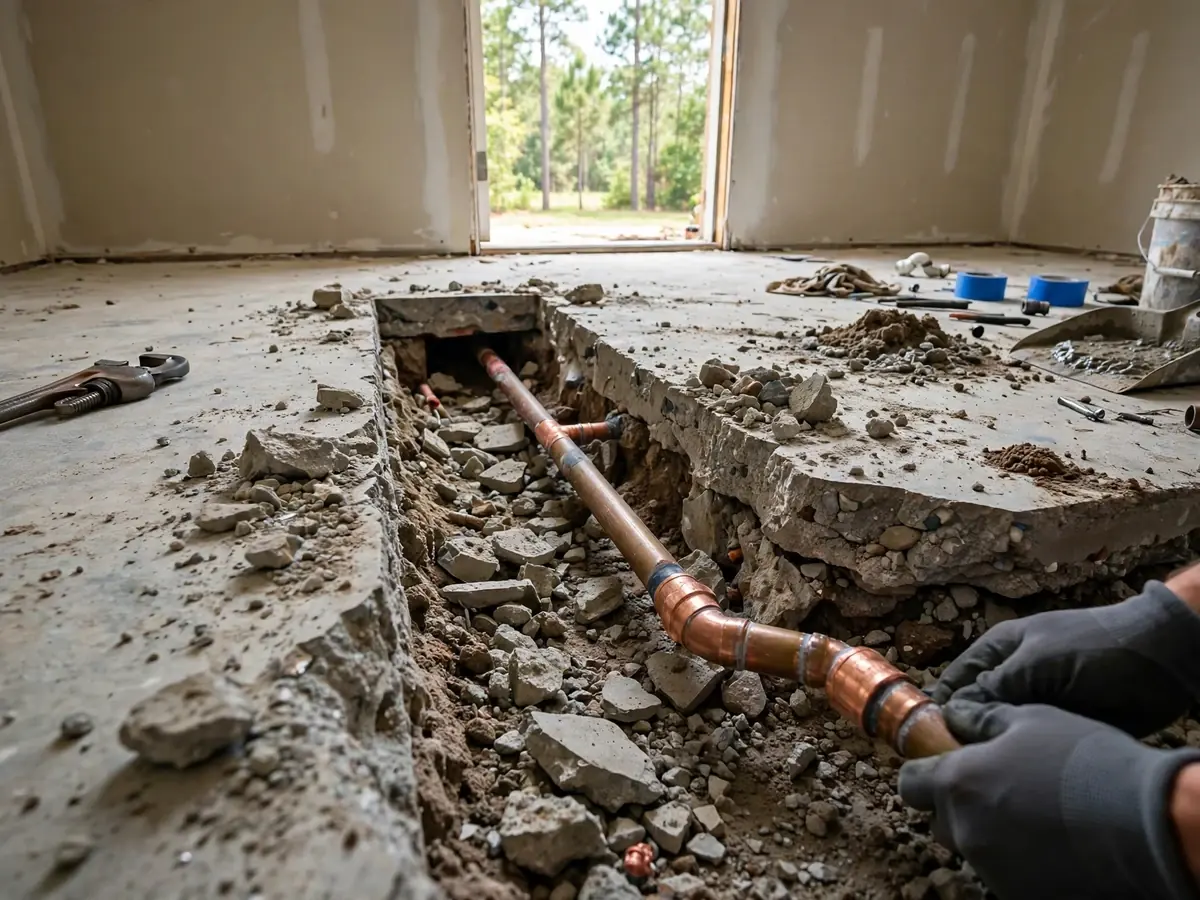
Checks you can do at home
Do the meter test
Turn off all water and watch the meter for movement.
Close the main
If the meter stops, the leak is inside. If not, it is outside.
Walk the floor barefoot
Feel for warm spots, especially along hot water lines.
Listen at quiet times
At night, put your ear near the floor and the walls.
If the water heater runs more than usual or the hot water is slow to arrive, a hot line may be leaking under the slab.
What happens if you wait
A slab leak does not heal. Water softens soil under the slab and can cause settling and cracks. It also feeds mold in the subfloor and under the flooring, and the water bill climbs the whole time.
Waiting also raises repair cost, since damage spreads. Call as soon as you suspect one. If water is already surfacing, close the main shutoff and call for emergency help.
Hot lines versus cold lines
Hot water lines wear faster because heat expands and contracts the pipe over and over. A slab leak on a hot line often shows as a warm patch and an unusually busy water heater.
Cold line leaks are quieter and may show only as damp flooring and a meter that moves. A pressure test on each line tells us which one is failing, and that decides the repair route.
Insurance and documentation
Many policies cover the water damage from a sudden leak but not the pipe itself, and they often exclude damage from slow leaks that went unnoticed. Read your policy and call your insurer early.
Keep the plumber report, photos of the damage and your meter readings. Clear records help a claim go smoothly, and we provide a written report of what we found at the end of every locate.
Quick notes on cost and timing
A locate is a small visit, and the repair price depends on the route chosen. A spot repair opens the floor in one place, while a reroute through the attic or wall avoids the slab altogether.
We explain both options and the trade offs, so the choice is yours. Most homeowners are surprised at how fast a locate goes once the leaking line is isolated.
Choosing who finds it
Pick a plumber who locates the leak before cutting. Ask what tools they use, whether they will show you the reading and whether the quote covers floor patching. A contractor who wants to start cutting without testing is guessing with your floor.
Check the license on the Contractors State License Board website before you hire. We locate first, show you the result and give a price before the work begins.
Preventing slab leaks
You cannot prevent every leak, but you can lower the risk. Keep water pressure within a safe range, replace worn pressure regulators and avoid chemical drain cleaners that stress pipe.
If your home has a history of pinhole leaks, ask about repiping before the next one. We serve Riverbank and Waterford as well as Oakdale.
Testing standards for a suspected leak
The Uniform Plumbing Code (UPC) relies on pressure testing to prove water piping is sound. A plumber uses the same approach to confirm a slab leak before any cutting begins.
Common questions
Often a faint hiss or a trickle when the house is quiet. It can be easier to hear at night.
You can test the meter and feel for warm spots, but pinpointing needs tools.
No. Radiant heating or a nearby heater can also warm a floor. A pressure test confirms it.
It depends on the leak size. Even small leaks can damage flooring and soil over months.
They are more often on raised foundations, where leaks are reachable from below. Newer slab homes see the typical slab leak problem.
Still have a question? Call (855) 575-2890 and talk to a plumber.