
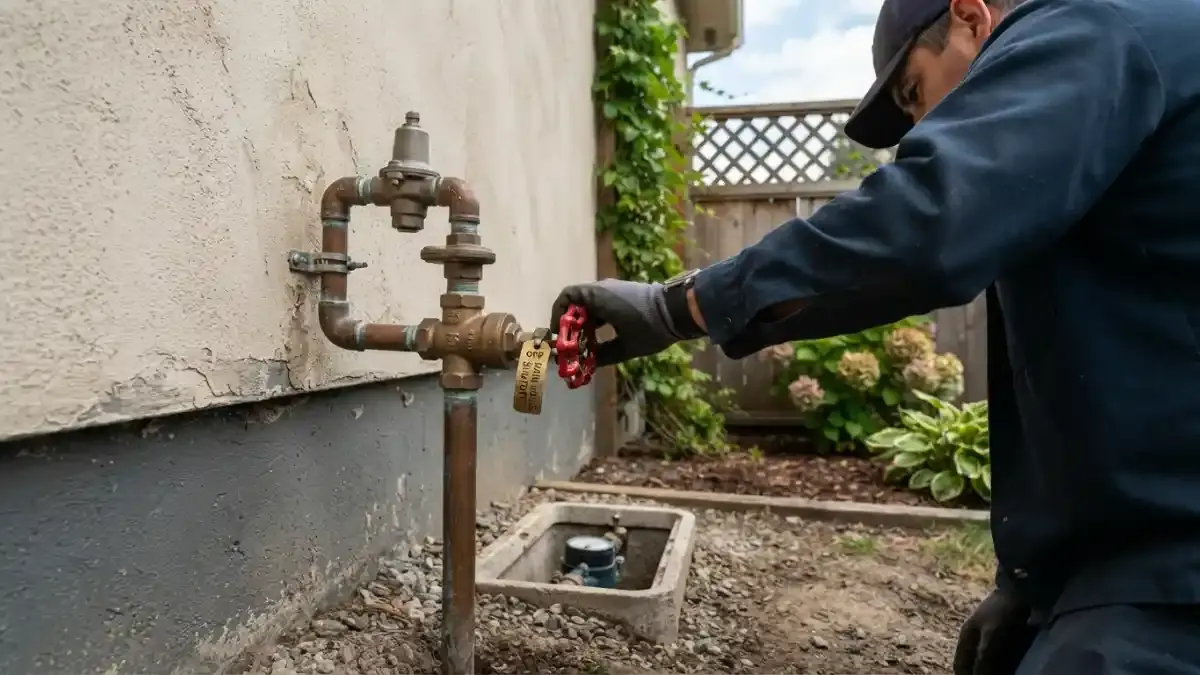
Test the valve once a year
Open a tap
Run a cold tap in the house so you can watch the flow.
Close the valve
Turn it off slowly and confirm the flow stops.
Reopen it
Open it fully, then back it off a little if it is a gate valve.
Check for drips
Look around the stem and the packing for any moisture.
If it will not turn or it drips after testing, call us. Forcing a seized valve can make a small problem into a flood.
Mark it and tell the family
Put a bright tag on the valve and tell everyone in the house where it is. In an emergency you may not be home, and a visitor or a family member needs to find it fast.
Keep a small adjustable wrench, a flashlight and a meter key near it. A photo of the valve on your phone helps too, since stress makes people forget.
Other shutoffs worth knowing
Each fixture has its own small valve, called an angle stop or a supply stop. Toilets have one on the wall behind the tank, and sinks have two under the basin. These valves let you stop a single leak without losing water in the whole house.
Water heaters have a cold supply valve above the tank, and washing machines have two valves on the wall box. Learn where each one is and test them once a year with the main.
What to do after you close it
Open the lowest tap in the house to drain pressure from the lines and slow the leak. Turn off the water heater if the lines are empty, since an electric element can burn out without water.
Then call a plumber and describe what you see. If water touched outlets or the panel, keep clear and call an electrician too. Take photos for your insurer before cleanup begins.
Teaching kids and guests
A shutoff only helps if someone can use it. Show teenagers and house sitters where the valve is and which way it turns. A quick walk through takes two minutes and can save a floor.
Renters should ask the landlord for the location and note it in writing. If a valve is blocked by storage, clear the path now, because a blocked valve is as useless as a missing one.
If you cannot find it
Not every house has an obvious valve. If you cannot find one, the water line to the house may only have the meter valve, which is not a good place for a quick shutoff. Installing a house valve is a short plumbing job.
We install full port ball valves at the house and can add a second at the heater. After an emergency, leak detection or burst pipe repair can follow. We serve Riverbank, Escalon and Oakdale.
Shutoff valves and the code
The Uniform Plumbing Code (UPC), reflected in the California Plumbing Code, calls for an accessible shutoff on the water service to a building and a valve at the water heater. A full port ball valve is the type most plumbers choose.
Common questions
Near where the line enters, often by the front hose bib, in the garage or in a utility room.
The meter valve is on the utility side, and some meters need a key. Use the house valve first.
Once a year is a good habit, so you know it works.
Stop and call a plumber. A leaking stem or a worn gate valve needs replacement.
Yes. We install a full port ball valve so you can close the water in seconds.
Still have a question? Call (855) 575-2890 and talk to a plumber.